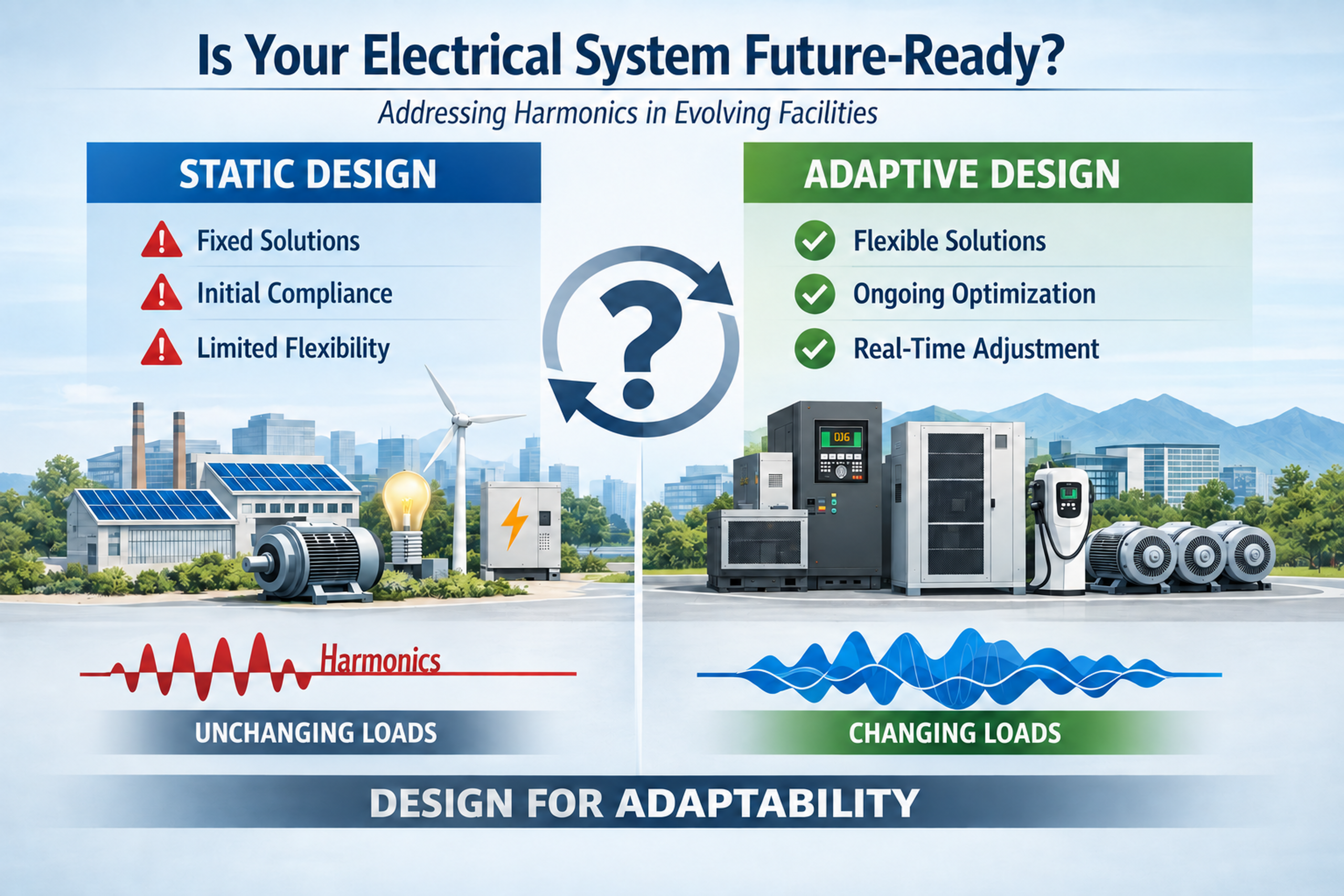
Is Your Electrical System Future-Ready
Compliance is Only the Starting Point
For years, power quality conversations have focused on the question:
How do we meet IEEE-519?
That question typically gets answered during design or commissioning. The system is modeled, mitigation is applied, compliance is verified, and the project moves forward.
But compliance on day one doesn’t guarantee compliance years later.
Facilities evolve. Production lines are reconfigured. New equipment is added. Efficiency upgrades introduce new harmonic signatures. What was once compliant may need a second look as the electrical profile of the facility changes.
A more relevant question is:
Is our electrical system ready to adapt to the future?
Harmonics Are a Moving Target
Harmonic distortion is not static. It is directly tied to how a facility operates.
Variable frequency drives, EC motors, LED lighting, and charging systems rarely operate at steady state. As utilization changes and operating conditions shift, harmonic content shifts with them.
Treating harmonic mitigation as a one‑time design decision ignores this reality. Power quality must be viewed as a dynamic system attribute, not a fixed condition established at commissioning.
Adaptive Harmonic Mitigation Strategies
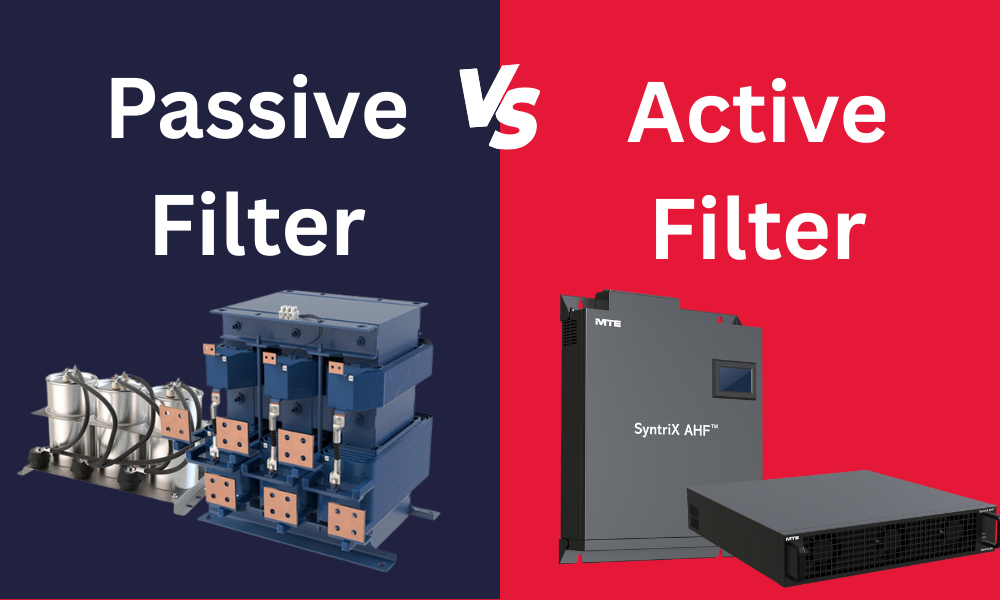
Active harmonic filters continuously monitor system current and dynamically compensate for harmonic distortion in real time. As load conditions change, mitigation changes with them. In environments with fluctuating or diverse non‑linear loads, that adaptability can be critical to maintaining long‑term power quality performance.
That said, passive harmonic filters still play an important role. For large, predictable, steady‑state loads, they remain reliable, efficient, and cost‑effective.
The goal isn’t choosing active or passive – it’s being intentional about how mitigation aligns with system behavior:
- Stable, high‑power loads may favor passive solutions
- Variable or expanding load profiles often benefit from active filtering
- Line or load reactors can reduce harmonic current upstream and improve overall system performance
In many modern facilities, the best approach is a thoughtful combination of mitigation strategies aligned with how the system actually operates—not just how it was originally designed.
Design for Adaptability, Not Just Today’s Load
The larger issue isn’t harmonic distortion itself.
It’s change.
Electrical systems are no longer static capital investments. They are evolving platforms that must support automation, electrification, and efficiency initiatives over time. As those initiatives accelerate, harmonic profiles will continue to shift.
Facilities that stay ahead of power quality challenges won’t be the ones designed solely for initial compliance.
They will be the ones designed for adaptability.
Meeting IEEE-519 still matters. But long‑term stability, efficiency, and scalability matter just as much.
The real strategic decision isn’t just which filter to install—it’s whether your electrical system is built to handle what comes next.
Related News & Articles
Harmonic Consideration for Data Centers
Harmonic Consideration for Data Centers By Rick Hombsch Director of Engineering - MTE What are harmonics? Harmonics in an electrical system refers to unwanted...
The Importance of Power Quality in Data Centers
The IT equipment housed in data centers is the heart of modern society and business. This is where the software that runs the world lives—supporting everything from cloud computing and financial systems to healthcare, logistics, and artificial intelligence. Data...
Passive vs. Active Harmonic Filters: Which Is Right for You?
With the drive to improve efficiencies, facilities are increasingly integrating variable frequency drives (VFDs), electronically commutated (EC) fans, and other nonlinear loads into their systems. However, this equipment introduces an often-overlooked challenge:...