
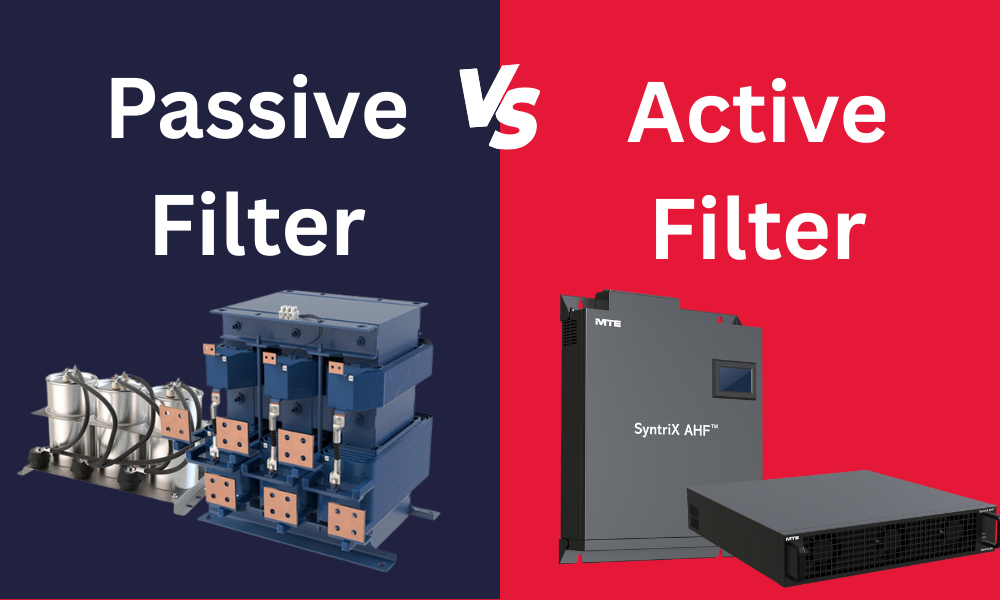
With the drive to improve efficiencies, facilities are increasingly integrating variable frequency drives (VFDs), electronically commutated (EC) fans, and other nonlinear loads into their systems. However, this equipment introduces an often-overlooked challenge: harmonic distortion. Harmonics can reduce system efficiency, disrupt sensitive equipment, and create compliance risks. As nonlinear loads continue to increase, harmonic distortion is an increasingly significant concern in modern electrical systems.
Two proven solutions to address harmonic distortion are — Passive Harmonic Filters and Active Harmonic Filters. While both improve power quality, each performs best under specific operating conditions and offer distinct advantages. The guidelines below can help determine which option will provide the optimal balance of protection, performance and reliability for your system.
What’s the Difference Between Active and Passive Harmonic Filters?
Passive Harmonic Filters rely on inductors, capacitors, and resistors tuned to specific frequencies to reduce harmonics. These solutions are installed ‘one-to-one’ – one filter installed to mitigate one point of harmonics. Passive Harmonic Filters are excellent at reducing targeted harmonic orders and work best with steady, predictable loads. In general, passive filters are rugged, simple and reliable.
Active Harmonic Filters, on the other hand, are high-tech, smart and adaptable. They use power electronics and digital control to continuously monitor and correct harmonics in real-time. These solutions can be installed as a ‘one-to-many’ solution – installing one active filter to mitigate many points of harmonics. They dynamically inject compensating currents within milliseconds, adapting instantly to load changes, which makes them ideal for facilities with variable or unpredictable loads.
When to Use a Passive Harmonic Filter
Passive filters are ideal for stable and predictable applications. Their simple construction and durability make them well-suited to harsh environments and low-maintenance operations.
Consider a Passive Harmonic Filter when you have:
- Steady or consistent electrical loads
- Rugged and/or high-temperature operating environments
- Limited maintenance capabilities
- Auxiliary power constraints
- Few points of harmonic distortion
When the harmonic profile is well-defined, passive filters provide dependable harmonic mitigation for long-term use.
When to Use an Active Harmonic Filter
Active filters excel in dynamic, complex, or high-performance systems. They deliver precise harmonic mitigation across a broad frequency range and maintain consistent performance as loads fluctuate.
You should consider an Active Harmonic Filter when your system includes:
- EC fans or multiple smaller loads
- Uneven or fluctuating loads across drives or equipment
- Plans for system expansion in the future
- A need for both harmonic mitigation and power factor correction
- Tight installation space or modular design requirements
- Many points of harmonic distortion
Their adaptability makes active filters ideal for facilities seeking high efficiency, flexibility and continuous IEEE-519 compliance.
Making the Right Choice
When deciding between an active and a passive harmonic filter, think about:
- Load Type: Is it steady or variable?
- Scope: Are you mitigating harmonics at a single load or across multiple loads?
- Environment: Will it operate in a controlled or harsh setting?
- Future Plans: Do you expect your load profile to grow or change?
| Choose Passive | Choose Active | |
| Load Type | Steady / Predictable | Variable / Fluctuating |
| Filtering Method | Fixed frequency (tuned) | Dynamic, adaptive |
| Operating Environment | Rugged, low maintenance | Controlled or space-limited |
| Temperature Sensitivity | Tolerant | Requires regulated cooling |
| Harmonics Covered | Specific Orders | Broad spectrum
(up to 50th order) |
| Response Time | Fixed | Milliseconds |
| Power Factor Correction | Limited | Integrated |
| Relative Cost | Lower upfront | Higher upfront, lower lifecycle |
The Bottom Line
Both Active and Passive Harmonic Filters effectively improve power quality and support IEEE-519 compliance. The right choice depends on your system characteristics and performance priorities.
MTE offers a robust selection of passive filters under our Matrix® brand as well as one of the most advanced active harmonic filters on the market – SyntriX AHF™. For application support or selection assistance, contact our Applications Engineering Team today!